I keep coming back to the same practical question: when I give important work to one AI agent, how do I know the answer is actually good?
My answer has become to use more than one agent, with different jobs. One explores, another tries to find what the first missed, and a separate pass checks the result against evidence. In my own work, doing this well has felt as much as ten times more effective at getting high-quality work done than asking one agent to carry the whole project.
That ten-times description is my experience, not the result of a controlled study. I have not run a timed comparison with fixed tasks, identical models, or blinded quality scores. I am describing a repeated difference I notice in the work I can actually use: more useful angles, fewer unchecked assumptions, and a better chance of finding weak spots before they become expensive. The published research is more mixed, and it helps explain why the way the agents work together matters more than their number.
More agents can mean different things
People use “multi-agent” to describe a few different arrangements. They are not interchangeable.
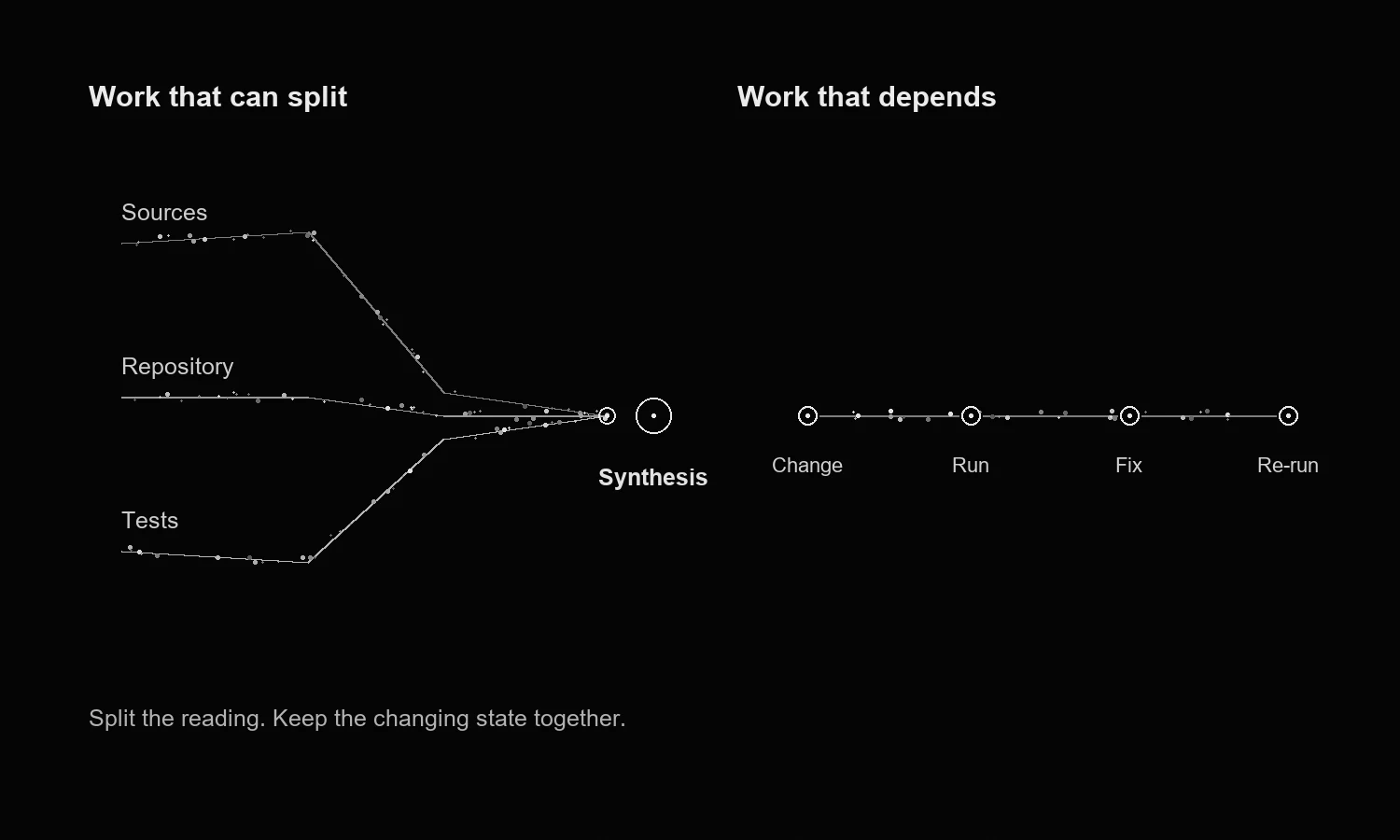
- Parallel work: agents take separate, bounded pieces of a larger task, then someone brings the pieces together.
- Independent review: one agent makes a proposal, and another gets the evidence or result and looks for specific errors.
- Debate: agents exchange arguments and try to persuade one another toward an answer.
- Shared workspace: agents can see relevant changes, test results, and decisions as work moves forward.
The first two create useful separation. The last can keep a team oriented. Debate can help surface opposing explanations, but agreement between models is not proof. If every agent inherits the same wrong premise, they may simply repeat it with more confidence.
The research is conditional, not a victory lap
A 2026 Nature Machine Intelligence study tested 260 agent configurations across six benchmarks, five architectures, and three model families. The authors found that collaboration could help or hurt depending on the task and on how strong the single-agent baseline already was.
On Finance Agent, a centralized multi-agent setup raised the mean score from 34.9% to 63.1%. On PlanCraft, every multi-agent architecture they tested scored 39% to 70% below its single-agent baseline. The same strategy did not travel cleanly from one task to another.
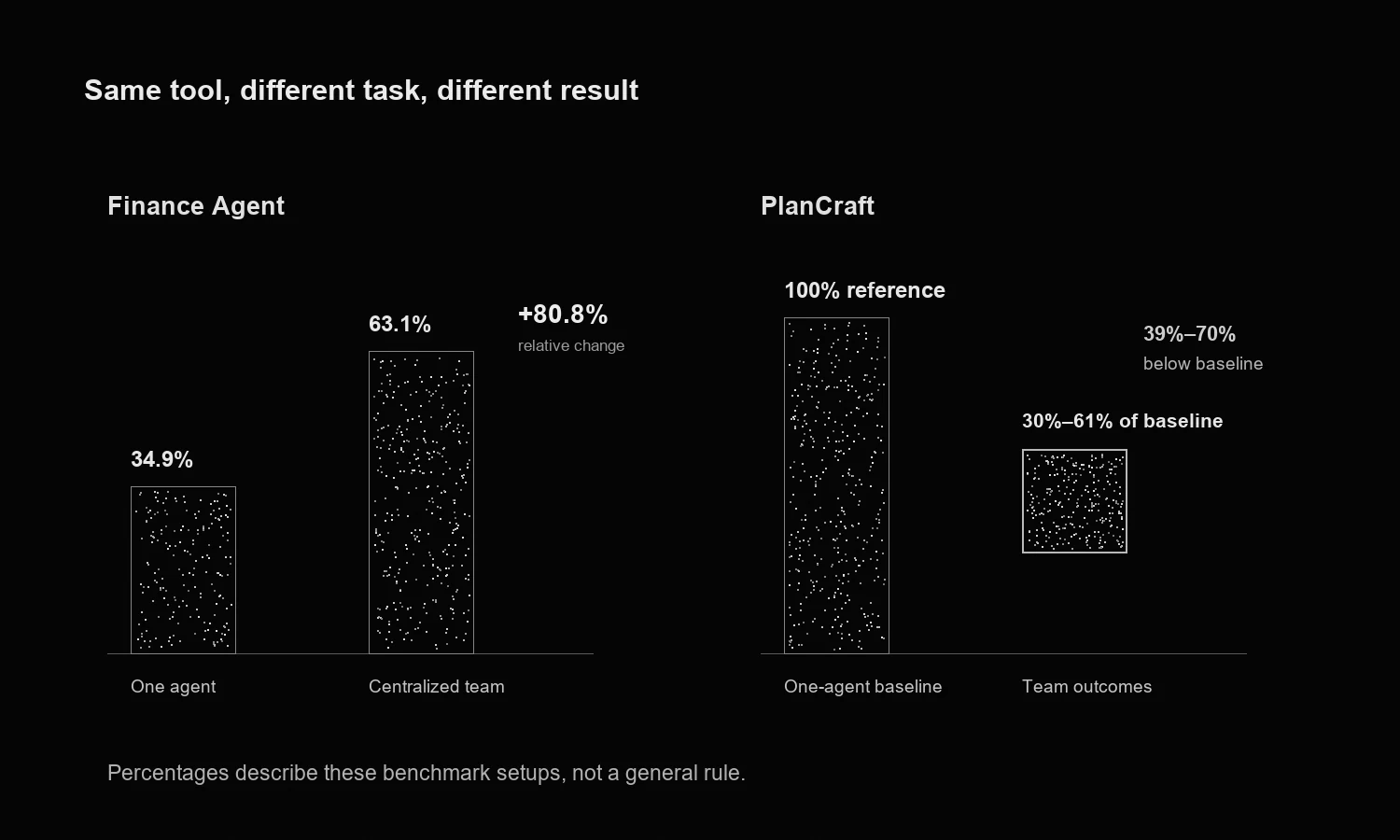
Those are results from named benchmark setups, not a forecast for any team using AI. The authors offer a roughly 45% single-agent success threshold as an empirical clue in their evaluated settings, while cautioning that the evidence is limited and it should not be treated as a universal rule. The useful takeaway is not “always add agents.” It is “check whether collaboration has room to help on this task.” Kim et al., “Capable language models can outgrow the benefits of collaboration,” Nature Machine Intelligence (2026).
For my own work, this matches what I have noticed. When a question has several independent angles, parallel investigation is useful. When the work is tightly connected and each step changes the same files or assumptions, adding voices can create a queue of coordination instead of progress.
The useful part may be seeing each other’s work
A 2026 empirical software-engineering study looked at two agents working in a shared Git workspace. In its PASC setup, agents could observe each other’s commits, lifecycle events, tests, and errors. That setup outperformed an isolated solo baseline on the study’s evaluated SWE-Bench Pro Python tasks. A two-agent setup without the peer activity feed was statistically equivalent to the solo baseline.
The authors also reported about 20% lower cost per resolved task and 47% fewer destructive concurrent edits for PASC compared with the silent two-agent setup. This is a specific result from a particular coordination design, two independently developed models, and one benchmark subset. It does not establish that shared workspaces always win. It does show why “two agents” is an incomplete description. Visibility into what the other worker changed may matter more than having another worker at all. Özaytürk and Buzluca, “Coordinating Agents on a Shared Git Workspace,” ESEM (2026).
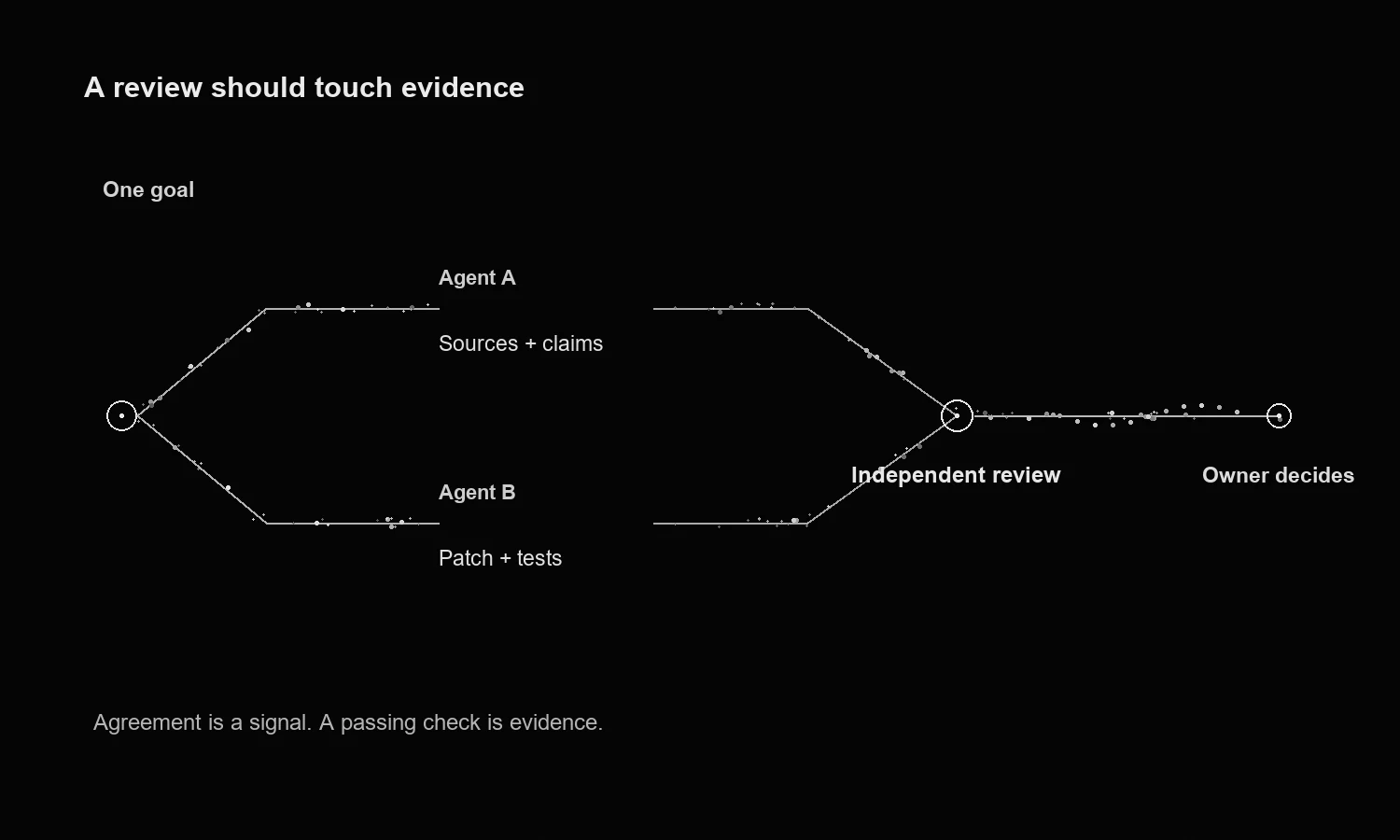
This is why I try to make the work visible. A reviewer should be able to see the actual output, not only a confident summary of it. A code reviewer should see the patch and test output. A research reviewer should see the cited material and the claims it is meant to support. The person responsible for the project should be able to see what is still uncertain.
Agreement can be a weak test
One common idea is to let agents debate until they agree. But a 2025 NeurIPS paper comparing debate with voting across seven NLP benchmarks found that majority voting accounted for most of the gains commonly credited to multi-agent debate. Its analysis warns that discussion itself does not guarantee a more correct answer. Choi, Zhu, and Li, “Debate or Vote,” NeurIPS (2025).
An earlier ICLR study found a similar caution in reasoning tasks: multi-agent debate did not reliably outperform self-consistency when given the same number of model responses. The work is narrower than the range of tasks people now assign to AI agents, but the distinction is important. Multiple samples can improve the chance that one is right. That does not mean the agents have checked one another’s work. Huang et al., “Large Language Models Cannot Self-Correct Reasoning Yet,” ICLR (2024).
I want an agent to challenge a claim with a reason I can inspect: a failing test, a missing source, a contradiction in the requirements, or an edge case the first pass did not handle. “I disagree” is a starting point. It is not a review result.
Coordination failures are real work
The failure modes are not theoretical. MAST, a 2025 study of more than 1,600 multi-agent execution traces across seven frameworks, organized recurring failures into 14 categories spanning system design, agent misalignment, and task verification. Its traces are from selected systems and tasks, so the categories are a useful map, not a universal failure rate. Cemri et al., “Why Do Multi-Agent LLM Systems Fail?” NeurIPS (2025).
CooperBench, a 2026 preprint on coding agents, gives a more concrete example. In more than 600 tasks built around two agents implementing separate features in real repositories, cooperating agents had 30% lower success than solo agents. The tasks deliberately stressed coordination, and the paper is a preprint, so that result should not be generalized to all collaborative work. Its examples of vague handoffs, missed commitments, and incorrect assumptions about another agent’s plan are still familiar failure patterns to watch for. Khatua et al., “CooperBench: Why Coding Agents Cannot be Your Teammates Yet,” arXiv preprint (2026).
The cost is easy to underestimate. Each agent adds context to provide, outputs to reconcile, and chances for duplicated effort. In code, two agents can overwrite the same change. In research, they can cite the same weak source and mistake repetition for independent corroboration. In strategy, one can quietly treat another’s guess as settled fact.
The pattern I use
I get the most from multiple agents when I set up the task so that disagreement can reveal something concrete.
- Write down what “done” means. Name the deliverable and the conditions it must meet. “Review the launch plan” is vague. “Find factual claims without a source, dependencies with no owner, and steps that cannot be tested” gives the reviewer something to do.
- Split work by evidence or artifact. One agent can research the market, another can inspect implementation constraints, and a third can draft a plan. Keep their tasks separate enough that they are not all repeating the same first pass.
- Give the reviewer the actual result. Ask it to challenge specific claims, changed files, or tests. Require it to point to the exact evidence behind each concern.
- Keep shared decisions visible. When an assumption changes, record the decision where the other workers can find it. For code, make changes inspectable and run tests after merging. For research, keep source links beside claims.
- Let an independent check settle disagreements. Run the test, read the source, inspect the rendered page, or ask the accountable human to decide. Do not count an agent vote as a passing check.
- Compare the result with a solo baseline. Look at usefulness, errors caught, rework, elapsed time, and cost. Keep the workflow where it helps, simplify it where it slows the project down.
Where I still use one agent
I do not add a team to every task. A small, well-specified change may be quicker to implement and test directly. A question with one authoritative answer may need a source check more than a debate. A tightly coupled task may be better handled by one agent with a clear plan, then reviewed by someone who did not write it.
I reach for multiple agents when the task is broad enough to benefit from distinct lines of thought, the cost of a missed assumption is meaningful, and I can give each worker a different contribution. I keep the final decision and the standards for done with a person.
What my “ten times” means
The number I opened with is a way to describe the difference I feel in practice, not a measured productivity claim. It means that a deliberate process of doing the work, challenging it, and checking it has repeatedly given me output I can trust and use at a level I was not getting from a single undirected pass.
I would want a real comparison before putting a precise multiplier on it: similar tasks, the same model and tools, a defined quality rubric, time and cost logged, and someone scoring the final work without knowing which workflow made it. Until then, my account belongs beside the research as firsthand experience, not inside its benchmark results.
The larger point is one I have seen enough times to keep using: one agent can produce an answer. A good process gives that answer somewhere to go, someone to question it, and a way to find out whether the work holds up.
Sources and scope
The studies above use different benchmarks and coordination designs. Some are peer-reviewed papers, while CooperBench is a preprint. None measures my own work, and none establishes a universal best number of agents. I have linked each study where it is discussed so readers can inspect the setup and limitations themselves.
- Kim et al., “Capable language models can outgrow the benefits of collaboration,” Nature Machine Intelligence (2026)
- Özaytürk and Buzluca, “Coordinating Agents on a Shared Git Workspace,” ESEM (2026)
- Choi, Zhu, and Li, “Debate or Vote,” NeurIPS (2025)
- Huang et al., “Large Language Models Cannot Self-Correct Reasoning Yet,” ICLR (2024)
- Cemri et al., “Why Do Multi-Agent LLM Systems Fail?,” NeurIPS (2025)
- Khatua et al., “CooperBench: Why Coding Agents Cannot be Your Teammates Yet,” arXiv preprint (2026)